


MACN/CBi Helpdesk reduces corrupt demands at seaports by 81%-Report…Improves foreign vessels’ perception
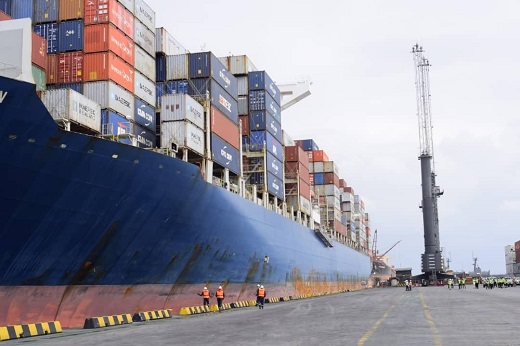
The establishment of a Helpdesk for vessel clearance by the Maritime Anti-Corruption Network MACN in affiliation with The Convention on Business Integrity CBi designed to support the feedback function of the Port Service Support Portal PSSP has reduced corrupt demands by government officials by over 80.9per cent percent in two years.
The MACN, formed in 2011 has in collaboration with the CBi been implementing an ambitious initiative designed to strengthen integrity and improve the operating environment in Nigeria’s seaport and terminals in conjunction with Federal Government’s Project Steering Committee PSC of the PSSP.
Founder/CEO, MACN, Soji Apampa, who addressed the media in Lagos, Wednesday, disclosed that in addition to reducing the clearance time for vessels calling at the nation’s seaports, the Helpdesk has also reduced incidences of demands by government officials on foreign vessel captains from 268 in 2019 to 126 in 2020 and further down to 51 cases so far in 2021, which represents a decline of 80.9per cent.
He noted that the Helpdesk, domiciled at the Nigerian Shippers Council and designed to improve efficiency and respond to incidences of corrupt demands at the nation’s seaports and terminals, has also enabled the tracking of performance data against established service level agreements as well as creating assurances and improved perception among foreign vessels entering Nigeria’s waters.
While insisting that sustaining this momentum will yield more benefits for the country in terms of image and economic activities and investment in the maritime industry, he hinted that plans are underway to extend the Helpdesk to cover the cargo clearance aspect of port operations.
He listed other key successes recorded in the implementation of wider port reforms to include the conduct of a Corruption Risk Assessment in the port sector led by the Technical Unit on Governance and Anti-Corruption Reforms TUGAR under the presidency and the Independent Corrupt Practices and Other Related Offences Commission ICPC and the Bureau for Public Procurement BPP.
According to him, the Corruption Risk Assessment formed the foundation and influenced the approach to the implementation of port reform strategy currently being implemented by the Federal Government and supported by the MACN and CBi. It was gathered that the key achievement of the Assessment Report was to identify key corruption- related risks in business processes and the operating environment in which personnel of various government agencies operate and recommend appropriate measures to improve the systems in place.
Others include the development of an application that houses the Standard Operating Procedures SOPs of key port operating government agencies in the country, for instance the Nigeria Customs Service in order to track and ensure compliance with set standards. It also established a Steering Committee drawn from the Federal Ministry of Transport, TUGAR, ICPC and the Lagos Chamber of Commerce and Industry LCCI to provide guidance and coordination for the MACN/CBi project implementation in Nigeria.
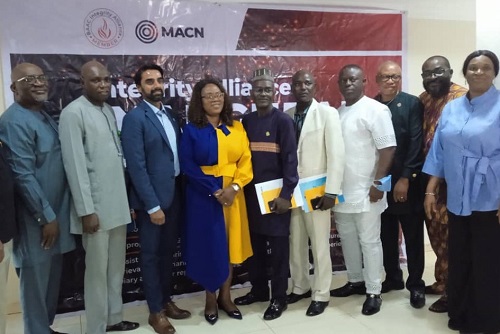
Also achieved was the setting up of a Business Action Against Corruption BAAC, Integrity Alliance Steering Committee made up of private sector and civil advocacy stakeholders from the three port zones covering Lagos, Calabar and Port Harcourt. This alliance collaborates with the government and leverages collective action to deepen efforts to promote transparency and accountability at the ports, address regulatory inconsistencies and administrative bottlenecks, strengthen self-regulation and integrity among private sector operators in the industry and push for operational efficiency at the ports while prioritising cost-efficiency.
The MACN/CBi has additionally, through the project trained in excess of 100 officers of the Nigeria Immigration Service on leadership, compliance and ethics drawn from the institution’s code of conduct.
It was gathered that the MACN/CBi in 2022 plans to extend the training to additional 200 officers drawn from agencies operating at the seaports and terminals including Customs, the Nigerian Maritime Administration and Safety Agency NIMASA, the Nigerian Ports Authority NPA and the Nigerian Port Health.
Investigations also show that some of the key successes recorded by the project are being studied by other maritime regulatory agencies and industry actors in Egypt and Ukraine to replicate same even as other countries such as India and Argentina, which are looking for ways to improve and reduce corruption in their port operations are watching with keen interest.
The Founder however regrets that while progress and achievements of this initiative are laudable, corruption and operational inefficiencies at the ports still remain a major challenge, a development that will require a long term commitment and action to address.
The MACN, established in 2011, represents over 140 shipping lines, which account for over 50per cent of the total global goods tonnage. It is a global maritime business network working towards the vision of a maritime industry free of corruption, which enable fair trade to the benefit of the society. The MACN has become a preeminent example of an effective and multi-sectoral collective action to tackle corruption around the world.
On the other hand, the CBi Nigeria, which has been in existence since 1997, is a Nigerian non-profit organisation. It has been in the forefront of promoting ethical business practices, transparency and accountability as well as fair competition in the public and private sectors through capacity strengthening and advocacy that promotes behaviour change and institutionalises good governance and integrity systems at all levels of organisations that operate in different sectors.


Leave a Reply