


NLNG urges global gas industry to prioritise methane reduction
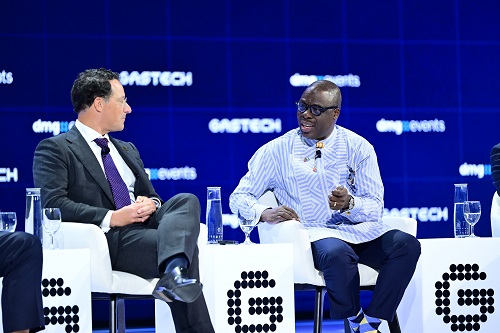
From right: Managing Director/CEO, NLNG, Adeleye Falade and one other participant during a panel session at the Gastech 2026 Exhibition and Conference in Bangkok.
NLNG has urged the global gas industry to make methane reduction a business priority, saying every tonne of methane released into the atmosphere represents lost revenue and gas that could otherwise reach the market. The company said its experience shows that investment in reducing these losses can pay for itself while cutting emissions and improving plant efficiency.
NLNG’s Managing Director/CEO, Adeleye Falade, made the call at Gastech 2026 Exhibition and Conference in Bangkok during a panel entitled: “Capturing the Lost Opportunity: Driving Global Alignment on Methane Abatement Across Natural Gas Supply Chains.” He said the NLNG approach starts with measuring methane losses and using the findings to guide investment in leak prevention and gas recovery, with independent verification to ensure credible reporting.
Falade said the industry needed to shift the conversation from the cost of methane reduction to the value it creates, recognising that preventing gas losses serves both commercial and environmental objectives.
“Every tonne emitted is lost product, lost revenue and lost energy; gas we could have sold. Every molecule of methane avoided is both an emissions reduction and a recovered energy resource,” he said.
He cited NLNG’s new boil-off gas compressor and start-up gas recovery project as examples of investments that support this approach. Each project targets methane reductions of approximately 10–15%, and both have positive projected net present values, meaning their anticipated financial benefits exceed their costs over the life of the projects.
“The most compelling business case is the simplest one: the projects that cut our methane also pay for themselves. The same discipline that reduces methane also improves asset reliability and plant efficiency. The returns show up in more places than the emissions ledger.” Falade said.
He explained that credible measurement underpins NLNG’s investment decisions, which allows the company to identify methane losses, direct resources to the right interventions and assess the results. He said NLNG’s experience demonstrates that gas producers in developing economies can establish globally trusted emissions-reporting systems by investing in monitoring infrastructure, building reporting capabilities and submitting their data to independent scrutiny.
Falade highlighted NLNG’s Gold Standard recognition under the Oil and Gas Methane Partnership (OGMP) 2.0 and said the company was the first in Africa to achieve Level 5 methane emissions reporting. He added that its measurement, reporting and verification (MRV) system is independently assured by DNV in accordance with ISO 14064.
NLNG’s approach includes site-wide optical gas imaging, a structured Leak Detection and Repair programme, and the phased deployment of continuous monitoring and real-time dashboards across its plant and vessels. Falade added that credible measurement is a function of commitment and not a function of geography and NLNG has proved it can be done in Africa.
Falade noted that NLNG had not waited for perfect infrastructure before taking action. It had prioritised credible measurement, invested in appropriate technology and strengthened its reporting through independent verification. The lesson, he said, was to raise standards across the industry rather than lower expectations for producers in emerging economies.
He said methane reduction was also being built into the design of NLNG’s Train 7 project, which will increase LNG production capacity from 22 million to 30 million tonnes per annum.
At national level, Falade said NLNG’s longstanding role in monetising gas that would otherwise have been flared had helped reduce Nigeria’s gas-flaring rate from over 65% to under 20%. He described the conversion of wasted gas into a marketable product as the original commercial case for emissions abatement.
He added that credible emissions data increasingly matters beyond plant operations, as methane intensity influences procurement decisions, financing and buyer confidence. For NLNG, this means extending the discipline of measurement and reduction throughout its supply chain.
Through its formal Scope 3 Advocacy Plan, the company engages feed-gas suppliers and contractors to measure, disclose and reduce emissions. NLNG also sources verified upstream emissions data from its feed-gas producers and incorporates environmental, social and governance considerations, alongside emissions criteria, into supplier selection and evaluation.
Falade on regulation called for greater consistency across jurisdictions, noting that differences in measurement methods and reporting requirements make enforcement uneven and meaningful comparisons more difficult.
“The industry does not need weaker standards; it needs stronger, shared ones backed by real measurement,” Falade said.
Addressing the balance between climate ambition, energy access and affordability, he said NLNG’s operations support Nigeria’s goals of net-zero emissions by 2060 and zero routine flaring by 2030. He stressed that progress on emissions reduction must go hand in hand with meeting the energy needs of households and businesses.
“Developing economies cannot be asked to choose between economic development and emissions reduction. Both must progress together,” he said.
He said NLNG’s approach brings together the practical requirements of energy supply and emissions management: measure losses credibly, invest in recovering gas and apply the same standards across the value chain.
Falade was joined on the panel by Zubin Bamji of the World Bank, Niels Dijksman of Brunei LNG and Hiroyuki Mori of JOGMEC. The session was moderated by Dr. Carole Nakhle, an energy economist with Crystol Energy.


Leave a Reply