


Maritime stakeholders propose reforms, infrastructure investments to jump-start Eastern Ports
Amid growing apprehension over the worsening imbalance in cargo and vessel calls between Nigeria’s seaports in Lagos and those located within the eastern part of the country, maritime stakeholders have urged the Federal Government to evolve urgent measures comprising critical reforms and massive investments in infrastructure to jump-start the operations of the seaports to bridge the widening gap.
The stakeholders, who listed the eastern seaports to include the Delta, Onne, Port Harcourt and Calabar Ports, noted that it was high time the government treated the modernisation of the seaports as national economic priority.
According to a communique issued at the end of a one- day conference organised by the League of Maritime Editors LOME, with the theme: “Lagos/Eastern: How to reverse existing imbalance in disproportionate cargo vessel calls”, the stakeholders called for a broader strategy for achieving complimentary reforms to drive the ports.
The conference, which held on August 20, 2026 at BWC Hotel, Victoria Island, Lagos, provided a platform for stakeholders to examine the longstanding imbalance in cargo vessel calls between Lagos and Eastern ports and to identify practical measures for developing a more balanced, competitive and efficient national port system.
The stakeholders further noted that the imbalance between Lagos and Eastern ports could be addressed through sustained reforms and infrastructure investment, describing the overall imbalance in cargo distribution as economically unhealthy, unsustainable for overall national development.
The stakeholders, who held extensive deliberations, paper presentations and contributions from diverse industry participants, observed that while Lagos ports currently handle a huge and disproportionate share of the nation’s maritime cargo, the Eastern ports, comprising Delta, Onne, Rivers and Calabar, trail behind, owing to a number of factors; including lack of resources for exports and paucity of imports; security concerns; etc.
The participants however admitted that though cargo distribution is driven largely by commercial considerations, including cost, efficiency, reliability, connectivity, vessel accessibility and quality of service, the low level of reforms and non-availability of modern infrastructure places the eastern ports in a disadvantaged position compared to their Lagos counterparts.
“It was also noted that some operational and economic policies which were politically motivated, hampers balanced cargo distribution and vessel calls into ports out Lagos.
“Participants were unanimous that the eastern axis ports require greater attention, sincere, workable and purposeful interventions from above-downwards within the political leadership ladder; horizontally and vertically; aimed at achieving an all-inclusive, efficient port system.
“Participants also observed that enforcement of policy blueprints are haphazardly and poorly implemented.
“Equally, participants spoke of the need to continue to improve on the nation’s overall capacity building in the maritime ecosystem, including the need to sustain quality maritime training and education of our youths.
“It was also observed that overall imbalance in cargo distribution is economically unhealthy and unsustainable”, the stakeholders said.
In the light of the above, participants recommended that the development of the Eastern ports should be treated as a national economic priority, especially, given their proximity to major industrial, agricultural, energy and commercial activities.
They equally sought for accelerated reforms and rehabilitation of the Eastern ports infrastructure, including deliberate and sincere channels management, honest and reliable dredging to support enhanced navigation and improved ports operations.
The participants equally called for honest and proper delineation of port support resource system, identification of unique potentials that supports designated port systems, and discouragement of the proliferation of politically motivated deep seaports.
They also proposed that the Federal Government should as a matter of urgency, look inwards and begin the identification of unique economic advantages that supports specialized port operations.
Other proposals include that a functional, seamless, multi-modal transport system and interconnectivity linking roads, rail, and inland-waterways to link the seaports for seamless movement of cargo.
The Communique reads in part: “Participants unanimously rejected politically imposed cargo quotas, in favour of cargo traffic flow that offers competitive, efficient and reliable services.
“A National Cargo Distribution Strategy and a National Port Competitiveness Index framework to guide cargo distribution and regularly measured performance of Nigerian ports was recommended.
“Participants expressed satisfaction with the wave of improvement in the quality of maritime training and the universal training curriculum in line with the guidelines of the IMO.
“It was also resolved that the Nigerian Ports Authority should step up its pilotage services on a round the clock basis to provide cargo ship owners the impetus to proceed to berth on a timely basis.
“Participants recommended reliable and trusted digitization of ports trade processes, one-stop-shop trade information flow and dispute resolution system, aimed at reducing physical contact and strengthening compliance and transparency.
“To scale up the improvement in cargo distribution in the eastern port corridor, participants prescribed a policy review and recalibration of our ‘captive cargo’ and ‘contestable cargo’ framework via a system initiative known as industrial recall; which system recognizes the economic advantage of all regional port system, built on the identified opportunities.
“Participants acknowledged that the imbalance between Lagos and the Eastern ports is the result of longstanding infrastructure, investment, operational and commercial challenges and cannot be reversed overnight.
“However, the conference affirmed that the imbalance can be addressed through sustained infrastructure investment, improved security and navigation, competitive pricing, digitalisation, efficient transport connectivity, economic industrial hubs through stronger public-private-participation model.
“Finally, participants urged regular publication of reliable port performance data to enable shipping lines, cargo owners and investors to make informed and reliable decisions based on actionable data and measurable performance.
“The conference therefore calls on the Federal Government and all stakeholders to pursue a competitive, balanced and efficient port system, in which Lagos remains a major maritime gateway while Onne, Rivers, Warri, Calabar and other viable ports are developed to attract a greater and more diversified share of the national and regional trade.”
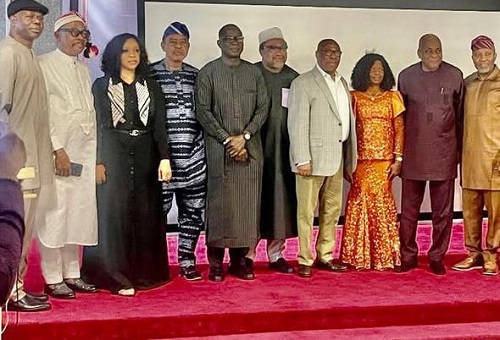
The one-day event brought together key industry stakeholders with participants drawn from the Federal Ministry of Marine and Blue Economy and agencies under it, including the Nigerian Ports Authority NPA, Nigerian Maritime Administration and Safety Agency NIMASA, Nigerian Shippers’ Council NSC, and the Maritime Academy of Nigeria MAN
The Nigeria Customs Service NCS, was also represented alongside a star parade of freight operators, maritime academics, and industry experts.
The Minister of Marine and Blue Economy, Dr. Adegobyeaga Oyetola CON was represented by the Director of Press, Mrs. Anastasia Ogbonna; the Managing Director of the Nigerian Ports Authority NPA, Director General, Nigerian Maritime Administration and Safety Agency NIMASA, Executive Secretary, Nigerian Shippers’ Council; Rector, Maritime Academy of Nigeria MAN, and the Council for the Registration of Freight Forwarders in Nigeria CRFFN, were represented by Engr. Seyi Iyawe, Edward Osagie, Mrs. Adaora Nwonu, Dr. Hakeem Lawal, and Madam Umoru Bintu, respectively.
The National Public Relations Officer of the Nigeria Customs Service, Deputy Comptroller Abdullahi Maiwada was represented by the Kirirkiri Lighter Terminal Command, CSC Victor Ogabor.
Participants at the event include: ACG Charles Edike, Rtd, Captain Iheanacho Ebubeogu, Mr. Lucky Amiwero, the Vice President of the Association of Nigerian Licensed Customs Agents ANLCA, Prince Segun Oduntan, Dr. Charles Okorefe of the Nigerian Maritime University NMU, Okerenkoko, Delta State, among several others.


Leave a Reply