


White House weighs Iran’s proposal to reopen Strait, defer nuclear talks
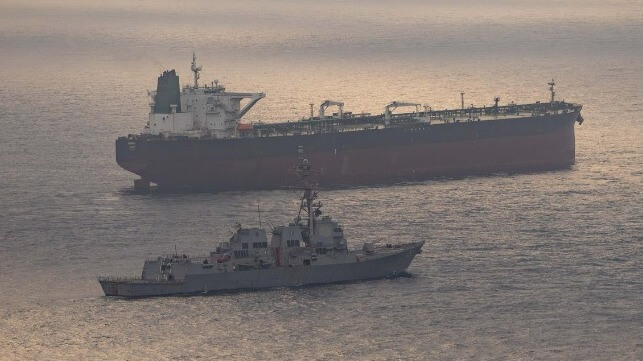
Guided-missile destroyer USS Rafael Peralta (DDG 115) enforces the U.S. blockade on Iranian ports against an Iranian-flagged ship attempting to sail to a port in Iran, April 24. Guided-missile destroyer USS Rafael Peralta (DDG 115) intercepts an Iranian tanker, April 24 USN.
Iran’s negotiating delegation has presented the White House with an offer to end the war and reopen the Strait of Hormuz, but with a price: the offer would be conditional upon pushing back the talks on Iran’s nuclear program to an unspecified future date. If the Trump administration accepted, it would perpetuate many of the activities that the White House hoped to eliminate, notably including the continuation of Iran’s uranium enrichment. The president does not like the proposal, multiple officials told the New York Times late Monday.
Under the plan, both Iran and the United States would relax their dueling blockades in the strait. That would allow commerce to flow freely to and from the Gulf states, restoring the world’s access to Arabian oil – subject to the timelines needed for demining the waterway and rebooting shut-in oil wells. It would also allow Iran to fully resume oil sales to China, a vital source of foreign exchange revenue which underwrites its military, its ballistic missile program and its nuclear enrichment activities.
Iran’s foreign minister, Abbas Araghchi, went on a tour of regional capitals over the weekend to sell the plan. He flew to St. Petersburg to meet with Russian President Vladimir Putin, then to Islamabad, then on to Muscat, where (according to Al Jazeera) representatives from multiple foreign intelligence agencies were on hand to meet.
Source: MARITIME EXECUTIVE


Leave a Reply