


NPA: Bua’s $85m Port Harcourt Terminal expansion project boosts Nigeria’s hub status
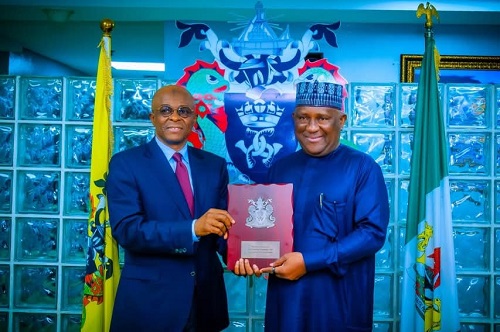
From left: Managing Director of NPA, Dr. Abubakar Dantsoho presents a souvenir to the visiting Chairman of the Bua Group, Alhaji Abdul Samad Rabiu at the NPA Marina, Lagos, headquarters, Thursday.
The Nigerian Ports Authority NPA, has said that BUA Group’s $85 million investment in the expansion of its Port Harcourt Terminal remains a major boost to Nigeria’s quest to emerge a leading maritime hub in West and Central African sub-region. The Authority insists that in addition to growing cargo throughput, it will also engender the utilisation of eastern ports.
The $85 million expansion is designed to significantly enhance BUA’s maritime logistics capacity while reinforcing the commercial importance of the Port Harcourt Port Complex.
Managing Director/CEO of NPA, Dr. Abubakar Dantsoho, who spoke when he led the top Management to host the Chairman of the Bua Group, Abdul Samad Rabiu, who was on a working visit to the NPA Marina, Lagos headquarters, described him as one of the Authority’s strategic stakeholders, assuring the company of continued institutional support.
According to him, NPA remains committed to investments capable of increasing cargo volumes, improving utilisation of eastern ports and strengthening Nigeria’s competitiveness within the regional maritime industry.
He noted that while BUA had already established a significant presence in Lagos, its decision to expand into the Port Harcourt Port would help rebalance cargo traffic across the country’s port system.
“Now we know that he has invested a lot in Lagos. Now he’s investing also a lot in Port Harcourt. So in that way, our volumes will increase. If we are talking about exporting, we are exporting more. If we are talking about importing, we can import more. And by so doing, we are going to create more value from those transactions.
“Increased cargo throughput at Port Harcourt would ultimately stimulate import and export activities, generate additional economic value and boost foreign exchange earnings.
“NPA’s strategy as a gateway to Nigeria’s economy and foremost trade facilitation platform, is anchored on close collaboration with terminal operators, investors and other stakeholders to build efficient, smart and globally competitive seaports.
“No doubt, BUA’s investment aligns with Federal Government’s drive to revive eastern ports to ease the pressure on the Lagos port corridor”, Dr. Dantsoho said.
He cited recent assessments by S&P Global and the World Bank, which ranked Apapa and Tin Can Island ports among the world’s most improved ports, saying the recognition reflects the positive impact of ongoing reforms within Nigeria’s port system.
He argued that sustained engagement between the NPA and private investors remains essential to achieving long-term growth and competitiveness.
“We know that we have to come to them. They know that they have to come to us. This is something that must happen for us to make any progress. And we are achieving that, so give God the glory,” he said.
Experts believe that beyond supporting the company’s industrial expansion, the project is projected to increase cargo traffic through the eastern maritime corridor, deepen private-sector participation in port infrastructure development and advance the Federal Government’s objective of achieving a more balanced and efficient national port system.
Chairman of BUA Group, Abdul Samad Rabiu, who spoke earlier, briefed the NPA top Management on the investment plan and the progress of the terminal expansion.
The Bua chairman, who thanked the NPA Management for continued support, disclosed that the project, now at an advanced stage, will provide about 600 metres of additional quay frontage, significantly increasing the company’s capacity to receive vessels and handle the growing volume of raw materials required for its expanding manufacturing operations.
He said “The expansion is driven by BUA’s rapid growth across its food and manufacturing businesses, with the company projecting that more than two million tonnes of raw materials and products will move through the Port Harcourt facility annually once the project is completed next year.
“By the time we are done with the expansion, inshallah, next year, we’ll be having almost over two million tonnes of products being imported as raw materials to Port Harcourt, and for that we need a terminal, we need a facility.
“This projected cargo volume would translate into about six to seven vessels calling at the terminal every month, making efficient port infrastructure indispensable to sustaining BUA’s supply chain.
“The investment also forms part of the conglomerate’s broader expansion strategy across cement, food processing, mining and infrastructure, and so, efficient maritime logistics remain central to the success of those investments.”
He also made a strong case for greater investment in port infrastructure outside Lagos, arguing that Nigeria’s economic size requires a more balanced and geographically diversified port system
Commending the NPA Management, Rabiu described the NPA as competent and supportive of private-sector investment, while thanking President Bola Ahmed Tinubu for appointing what he called a dedicated management team.
He recalled that BUA’s Port Harcourt terminal concession had previously been revoked but expressed satisfaction that the facility is now being expanded with the cooperation of the NPA, describing the development as evidence of the value of government-private sector collaboration.


Leave a Reply